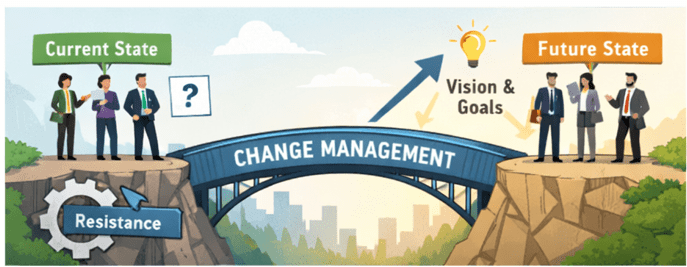
Change management is the structured discipline that helps organizations move from their current state to a desired future state by focusing on the human side of change. It ensures that transformation initiatives succeed by guiding employees, leaders, and teams through uncertainty, resistance, and adaptation.
🌍 What is Change Management?
Change management is a systematic approach to transition. It’s not just about rolling out new systems or processes—it’s about ensuring people understand, accept, and adopt them. At its core, it bridges strategic vision with operational reality, making sure that bold plans don’t collapse due to human resistance or misalignment.
Key aspects include:
- Communication & Alignment → Clear, consistent messaging from leadership.
- Training & Support → Equipping employees with skills and resources.
- Managing Resistance → Addressing fears, concerns, and pushback.
- Sustaining Change → Reinforcing new behaviors until they become the norm.
🔑 What Goes Into Change Management
Successful change management typically involves:
- Leadership Commitment → Leaders modelling new behaviors and setting the tone.
- Stakeholder Engagement → Involving employees early to build ownership.
- Structured Processes → Frameworks like ADKAR or Kotter’s 8-Step Model to guide transitions.
- Continuous Feedback → Listening to employees and adapting strategies.
- Cultural Integration → Embedding change into organizational values and practices.
⚠️ High-Level Challenges Faced
Even with strong planning, organizations often stumble due to:
- Employee Resistance → People naturally resist leaving their comfort zones.
- Leadership Misalignment → Mixed signals erode trust and slow adoption.
- Change Fatigue → Too many initiatives overwhelm employees.
- Skill Gaps → Teams struggle to adapt to new demands.
- Poor Communication → Lack of clarity breeds confusion and disengagement.
Why It Matters Without effective change management, even the most innovative transformation strategies fail. By focusing on the psychological and behavioral side of change, organizations can turn uncertainty into opportunity, ensuring smoother transitions and long-term success.
🧭 Summary
Change management is the art and science of helping people move confidently through organizational transitions. It aligns strategy with human behavior, ensuring that change isn’t just implemented but embraced. By combining clear communication, leadership alignment, and empathy for employee concerns, organizations can transform resistance into readiness. In essence, effective change management turns disruption into growth – making transformation sustainable, not just successful.
 Rise of Tribes
Leave a comment