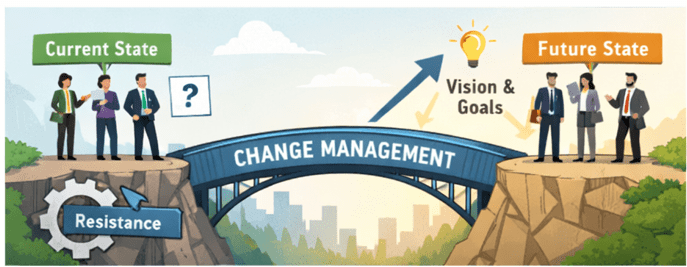
• Change management is the structured discipline that helps organizations move from their current state to a desired future state by focusing on the human side of change. It ensures that transformation initiatives succeed by guiding employees, leaders, and teams through uncertainty, resistance, and adaptation.

    🌍 What is Change Management?

    Change management is a systematic approach to transition. It’s not just about rolling out new systems or processes—it’s about ensuring people understand, accept, and adopt them. At its core, it bridges strategic vision with operational reality, making sure that bold plans don’t collapse due to human resistance or misalignment.

    Key aspects include:

    • Communication & Alignment → Clear, consistent messaging from leadership.
    • Training & Support → Equipping employees with skills and resources.
    • Managing Resistance → Addressing fears, concerns, and pushback.
    • Sustaining Change → Reinforcing new behaviors until they become the norm.

    🔑 What Goes Into Change Management

    Successful change management typically involves:

    • Leadership Commitment → Leaders modelling new behaviors and setting the tone.
    • Stakeholder Engagement → Involving employees early to build ownership.
    • Structured Processes → Frameworks like ADKAR or Kotter’s 8-Step Model to guide transitions.
    • Continuous Feedback → Listening to employees and adapting strategies.
    • Cultural Integration → Embedding change into organizational values and practices.

    ⚠️ High-Level Challenges Faced

    Even with strong planning, organizations often stumble due to:

    • Employee Resistance → People naturally resist leaving their comfort zones.
    • Leadership Misalignment → Mixed signals erode trust and slow adoption.
    • Change Fatigue → Too many initiatives overwhelm employees.
    • Skill Gaps → Teams struggle to adapt to new demands.
    • Poor Communication → Lack of clarity breeds confusion and disengagement.

    Why It Matters Without effective change management, even the most innovative transformation strategies fail. By focusing on the psychological and behavioral side of change, organizations can turn uncertainty into opportunity, ensuring smoother transitions and long-term success.

    🧭 Summary

    Change management is the art and science of helping people move confidently through organizational transitions. It aligns strategy with human behavior, ensuring that change isn’t just implemented but embraced. By combining clear communication, leadership alignment, and empathy for employee concerns, organizations can transform resistance into readiness. In essence, effective change management turns disruption into growth – making transformation sustainable, not just successful.

  • For a very long time, I had associated the chanting of OM to be religious or spiritual. In the last 2 years, I understood, there is a scientific nuance associated to this specific chant. This is a chant when combined with slow inhale and exhale (breathwork), helps moderate your nervous system, lowers anxiety, enhances your happiness hormones in the body, resulting in joy and relaxation.

    Physical health benefits
    1. Blood Pressure Regulation: Helps stabilize cardiovascular rhythms.
    2. Respiratory Health: Deep breathing during chanting improves lung capacity and oxygen intake.
    3. Pain & Fatigue Relief: Vibrations soothe the nervous system, reducing tension and fatigue.

    Scientific & Psychological benefits:
    🧠 Enhanced Brain Function – boosts gamma waves and clarity
    🌿 Stress Reduction – activates the vagus nerve, calming the nervous system
    💛 Emotional Balance – strengthens amygdala–prefrontal cortex connection
    ⚕️ Hormonal Harmony – increases serotonin, dopamine, and endorphins

    HOW TO? (Try this during the weekend)

    – Duration: 5-10 minutes, once or twice daily.
    – Method: Sit comfortably, inhale deeply, chant OM (chanting to extend as “A-U-M”) slowly, letting the vibration resonate in the chest, throat, and head.
    – Best Times: Early morning or before sleep for maximum calmness.
    – Integration: Use before meditation, yoga, or stressful events (presentations, exams, negotiations).

  • This week, don’t start with “Where can we use AI?” Start with “Which process is slowing us down the most?”

    Pick one high-volume workflow in your business, like hiring for your team, Production support, Tech approvals, onboarding a new member, Defect fixes or even Code merge to Master in a scrum team per sprint. Map the current steps, identify where delays happen (Simplified version of ‘Value Stream Mapping’ – VSM), and flag where AI can assist without removing human judgment.

    In one 45-minute session, you can usually find:
    1. One bottleneck.
    2. One repetitive task worth automating.
    3. One decision point that still needs human oversight.

    The goal is not to automate everything. The goal is to improve speed, consistency, and decision quality.

    If you lead a team, this is one of the fastest ways to create visible transformation without a large tech program.

    CTA: DM me for a simple process-mapping framework.

  • AI is no longer a back-office efficiency play, it’s a leadership imperative. Over 2026–27, AI will reshape decision-making, talent, governance, and competitive advantage. Leaders who treat AI as a tech project rather than a socio-technical transformation risk falling behind. Key shifts and actions are below.

    Hybrid human–AI decision ecosystems

    • What changes: AI agents will provide real-time recommendations, simulations, and risk assessments across functions.
    • Leadership shift: Move from sole decision-maker to designer of decision workflows.
    • Action: Map your decision inventory; pilot AI support in low-risk areas with clear human override protocols.

    From hiring to orchestration of AI talent

    • What changes: Platform tools democratize technical tasks; orchestration becomes the core skill.
    • Leadership shift: Build cross-functional, embedded AI squads rather than centralized silos.
    • Action: Create teams with product owners, data engineers, and domain leads; upskill managers for AI fluency; measure collaboration outcomes, not just headcount.

    Explainability and trust as board-level issues

    • What changes: Regulators, customers, and auditors will demand traceability of AI-driven outcomes.
    • Leadership shift: Make AI risk and accountability a board-level concern.
    • Action: Establish AI governance (owner, steward, auditor), mandate model documentation (data lineage, assumptions, failure modes), and run tabletop exercises for AI incidents.

    New AI-relevant performance metrics

    • What changes: KPIs will include AI health metrics such as model drift, human override frequency, and fairness indices.
    • Leadership shift: Expand executive scorecards to include AI indicators.
    • Action: Define 3 – 6 AI health metrics relevant to your business and tie part of incentives to responsible AI outcomes.

    Speed versus oversight trade-offs

    • What changes: Decision latency shrinks, increasing pressure to act quickly and risk cascading errors.
    • Leadership shift: Balance speed with guardrails and escalation paths.
    • Action: Implement staged automation (assist → suggest → act), set thresholds for human review, and monitor automated actions with real-time anomaly detection.

    AI literacy and ethical judgment for leaders

    • What changes: Executives need AI literacy and ethical decision-making skills, not necessarily technical depth.
    • Leadership shift: Include AI judgment in leadership competency frameworks.
    • Action: Launch short AI literacy programs and ethical scenario training for leaders and managers.

    Regulation, geopolitics, and employee experience

    • What changes: Fragmented regulations and market differences will affect data flows and product design; employee buy-in will determine adoption success.
    • Leadership shift: Elevate risk/ compliance and focus on empathetic change management.
    • Action: Map regulatory exposure by market, adopt privacy-by-design practices, co-design workflows with employees, and provide clear reskilling paths.

    AI in 2026–27 will reward leaders who treat it as strategic, not merely technical. Design robust decision ecosystems, orchestrate talent, embed governance, and lead with ethical clarity to convert AI into durable advantage. Act now: align strategy, metrics, and culture before automation accelerates past your organization’s guardrails.

    Prediction sources listed below

    • DDI, “Leadership Trends 2026: What’s Next for Leaders and Organizations” — useful for the idea that AI is already embedded in everyday leadership, that leaders need AI fluency, and that human + AI leadership is becoming a core trend.
    • IBM Think, “The biggest AI adoption challenges for 2026” — strong source for claims about agentic AI, governance, data quality, security, workflow integration, and the point that AI is more of a leadership than a technology challenge.
    • SSRN paper, “Artificial Intelligence in Leadership and Management: Current Trends and Future Directions” — useful for the broader academic framing of human-AI collaboration, decision-making improvement, ethical governance, and organizational adoption challenges.
    • IMD, “2026 AI trends: What leaders need to know to stay competitive” — helpful for positioning AI as a leadership and strategy issue rather than only a technology issue.

    Insight / DDI article, “The Real AI Challenge Is Leadership, Not Hiring” — useful for the talent and change-management angle.

  • Not every manager needs more experience – some need better support for the way work is changing. As teams move faster and expectations rise, AI leadership training can help managers lead more effectively, reduce friction, and make better decisions. Here are five signs it may be time.

    1. Their work is still too manual
    If managers are spending too much time writing meeting recaps, chasing updates, and organizing information, they are likely operating below their capacity. AI can help them streamline routine tasks and free up time for real leadership work.

    2. Team priorities keep getting lost
    When managers cannot clearly connect daily work to bigger goals, teams often drift. This usually shows up as scattered priorities, repeated clarification, and slow progress. AI training can help managers organize information faster and communicate direction more clearly.

    3. They avoid difficult conversations
    Some managers know they need to give feedback or address issues, but delay those conversations because they feel unprepared. AI can help them prepare talking points, structure feedback, and think through likely responses before the conversation happens.

    4. Their decisions rely on memory more than data
    If managers are making choices based on what they remember rather than what is current and visible, they may be missing important context. AI tools can help summarize patterns, surface trends, and support better decision-making with less effort.

    5. They use AI as a side tool, not a leadership habit
    Some managers may experiment with AI occasionally, but keep it separate from how they actually work day to day. That means AI becomes a one-off helper instead of a real advantage. The real value comes when managers learn how to weave it into planning, coaching, communication, and decision-making so it supports their leadership in a meaningful way. If these signs feel familiar, the gap is probably not motivation – it is capability. With the right AI leadership training, managers can spend less time on low-value work and more time on coaching, alignment, and execution.

  • Case study: From overwhelmed manager to high-impact leader — how AI training transformed coaching and 1:1s

    When Sam (name changed) stepped into his first manager role at a mid‑stage product company, despite his role change, he continued to be hands-on with coding, 1:1s were irregular and mostly status updates, frequent ad‑hoc meetings, etc. Within three months, delivery slowed and team morale dipped. The root cause wasn’t technical ability; it was scale. Sam was not given the right support on how to move away from an Individual contributor to a Manager, there was a lack of established practices and AI skills to make coaching efficient, run focused 1:1s, and reduce coordination overhead.

    Problem: Weak coaching cadence and noisy 1:1s

    • One‑on‑ones were consumed by status updates rather than development conversations.
    • Coaching didn’t scale; direct reports asked the same questions repeatedly.
    • Sam spent evenings drafting meeting notes and follow-ups, spent too much time coding himself, limiting his bandwidth towards strategic focus.

    Intervention: role‑specific AI training and redesigned 1:1 rituals
    Over two weeks Sam completed targeted training: prompt design for coaching, AI tools for meeting prep and follow‑up, and structuring repeatable learning paths. The program combined short demos, paired practice with an AI coach, and three focused pilots:

    • 1:1 prep prompts: automated pre‑meeting summaries that pulled recent tickets, PRs, and prioritized discussion topics from brief employee inputs.
    • Coaching micro‑plans: AI‑generated, 2‑week skill micro‑tasks tailored to each report (example: refactoring mini‑exercise, focused code kata*).
    • Follow‑up automation: AI-created concise action items and a 2‑line accountability note sent to the report after each 1:1.

    Outcome: measurable gains in 8 weeks

    • 1:1 prep time dropped by 50% because summaries and context were auto‑generated, allowing meetings to start on development topics immediately.
    • Direct reports completed coaching micro‑tasks at a 70% completion rate (tracked via short checklist in the team board), and progress showed in shorter PR cycles.
    • Repeated questions fell by 40%, measured as a reduction in repeated help requests logged in the team’s support channel.
    • Sam reclaimed two afternoons per week for stakeholder work and strategic planning.

    Why it worked

    • Coaching-first integration: AI supported coaching workflows rather than replacing human judgment, enabling higher‑quality, focused 1:1s.
    • Lightweight metrics: completion rate of micro-tasks and reduction in repeated help requests provided clear, operational measurements of impact.
    • Small, safe pilots: incremental experiments, built trust and normalised new rituals.

    Practical takeaway

    Start by automating 1:1 prep and follow-up with simple prompts, pair those with 2‑week coaching micro‑tasks, and track micro‑task completion plus help‑request volume. Those two metrics will show whether coaching is scaling—and free the manager to do higher‑leverage work.

    *code kata is a self-contained exercise in software development that emphasizes skill acquisition and the establishment of consistent coding routines rather than simply solving a problem. The term “kata” originates from Japanese martial arts, where it refers to a choreographed sequence of movements practiced repeatedly to achieve mastery

  • Every leader aims at steering their organization through a successful transformation—whether it’s digital adoption, cultural renewal, or a complete process overhaul. Yet research consistently shows that 50–70% of transformations fail. The surprising truth? It’s rarely the technology or strategy that derails progress. More often, it’s the human side of change.

    1. Resistance to Change

    Employees are the heartbeat of transformation, but they’re also the first line of resistance. Fear of job loss, skepticism about new systems, or simply the comfort of “how things have always been” can stall even the most well‑funded initiatives. Without early involvement and clear communication, resistance becomes a silent killer.

    2. Leadership Misalignment

    Transformation requires leaders to walk in lockstep. Yet many initiatives falter because executives disagree on priorities or fail to model new behaviors. When leaders send mixed signals, employees lose trust, hence momentum evaporates.

    3. Organizational Fatigue

    Change fatigue is real. When employees face wave after wave of new initiatives, burnout sets in. Transformation then feels less like progress and more like disruption. Leaders must pace change and celebrate small wins to keep energy alive.

    4. Unclear Goals & Unrealistic Timelines

    A transformation without a clear “why” is destined to fail. Vague objectives or overly ambitious deadlines create confusion and erode credibility. Employees need to see the destination and believe the journey is achievable.

    5. Siloed Execution

    When departments run parallel initiatives without integration, duplication and inefficiency creep in. Transformation is a team sport, here silos will only slow the game.

    6. Neglecting Culture & Behavior

    Frameworks and roadmaps look great on paper, but they don’t change mindsets. True transformation happens when people shift how they think, collaborate, and lead. Ignoring culture is like renovating a house without fixing the foundation.

    7. Skill Gaps

    Emerging technologies demand new skills. Yet many organizations underestimate the reskilling required. Without investment in learning, employees are left behind—and so is the transformation.


    The Leadership Lesson

    Organizational transformation does not fail because of poor strategy, it fails because leaders underestimate the human side of change. Success requires:

    • A clear vision and measurable goals
    • Aligned, committed leadership
    • Employee engagement and reskilling
    • Cultural shifts that embed new behaviors

    Transformation is not a project—it’s a capability. Organizations that treat it as an ongoing journey, rather than a one‑time event, are the ones that thrive.

  • Most individual contributors aren’t blocked by lack of skill; they’re blocked by how their work is seen.

    Being excellent at your job is important, but it is rarely enough to move your career forward. Many individual contributors do strong work every day and still remain invisible to leaders, sponsors, and decision-makers.

    The first mistake is believing your work will speak for itself. It usually won’t. If people do not know what you delivered, why it mattered, and what changed because of it, they cannot advocate for you. Visibility is not bragging; it is helping others understand your impact.

    The second mistake is staying silent in important conversations. Some ICs assume they need a manager title to speak strategically. In reality, your ideas become visible when you ask smart questions, share useful observations, and contribute before decisions are finalized. Consistent participation builds trust.

    The third mistake is talking about tasks instead of outcomes. Many professionals describe what they did, but not the value it created. Leaders remember business impact, not just effort. Instead of saying, “I completed the report,” say, “I created a report that helped the team spot delays early and save two weeks.”

    The fourth mistake is avoiding relationships beyond your immediate team. Visibility grows when people across functions know you, trust you, and understand your strengths. A strong network creates opportunities that performance alone cannot unlock.

    The fifth mistake is waiting for the perfect moment to be seen. There is no ideal time to start building visibility. You build it through small, repeatable actions: sharing updates, contributing in meetings, documenting wins, and making your value easy to notice.

    For individual contributors, visibility is not about becoming louder. It is about becoming clearer. When your impact is visible, your opportunities grow with it.

  • When I look back at my time as Director of Quality Engineering and other leadership roles at Honeywell, I see it as the crucible where my leadership philosophy was forged. I wasn’t just leading teams, I was shaping the future of a $300M business portfolio, advising the C‑suite, and driving innovation across complex, global systems.

    Engineering Excellence Meets AI Innovation

    At Honeywell, my mandate was clear: deliver quality at scale. That meant building AI‑driven testing strategies – integrating tools like Copilot, OpenAI, and Playwright into the software development lifecycle. We weren’t just testing code; we were figuring out the boundaries of what AI could do, from bias detection to hallucination control in generative models.

    In my tenure as a leader with Honeywell, I championed CI/CD pipeline maturity, ensuring automation wasn’t just fast but secure, reliable, and scalable. Every release had to meet the highest standards, and every process had to translate into meaningful business impact.

    The Shift: From Systems to People

    But here’s the truth: even the most advanced pipelines and AI strategies mean little if the people behind them aren’t aligned, empowered, and capable of leading change. I realized that transformation isn’t just about processes, it’s about mindsets, behaviors, and leadership capacity.

    That realization became the bridge to my current role as an Organizational Transformation Consultant, Leadership & AI Coach.

    Today: Catalyzing Transformation Beyond Engineering

    Now, I help:

    • Organizations build agility, scale, and efficiency by redesigning systems and processes while strengthening people capabilities.
    • Startups (Series B–D) create the ecosystems they need to scale sustainably, balancing innovation with structure.
    • Corporate professionals: From first‑time managers to executive leaders; unlock their potential, overcome “stuck” moments, and grow into confident, impactful leaders.

    My consulting blends organization design, NLP‑based behavioral training, leadership development programs, and workforce capability building. In essence, I’ve moved from optimizing tests and code to optimizing culture.

    The Common Thread

    Whether at Honeywell or in a startup boardroom, the common thread is transformation. At Honeywell, it was about engineering excellence through AI and automation. Today, it’s about human excellence through leadership and behavioral change.

    Key Takeaway

    Transformation is never just technical, instead it is deeply human. My journey from Director of Quality Engineering to Leadership & AI Coach reflects that truth: systems deliver outcomes, but people deliver impact.

  • In 2026, AI is not replacing managers. It is quietly changing what effective management looks like.

    A few years ago, a good manager was often judged by how much they knew, how quickly they could respond, and how well they could keep everything moving. Today, that definition is shifting. The managers who are standing out are not the ones trying to do everything manually. They are the ones using AI to reduce clutter, sharpen judgment, and spend more time on the human side of leadership.

    Consider a typical workday. A manager starts with a flood of emails, meeting updates, performance concerns, project delays, and team questions. In the past, much of the day was spent sorting through the noise. Now, AI tools can summarize meetings, draft follow-up notes, surface priorities, identify bottlenecks, and even help prepare one-on-one conversations. That means managers can spend less time reacting and more time leading.

    But the real transformation is not operational. It is behavioral. AI is pushing managers to become better coaches, better decision-makers, and better communicators. When routine tasks are automated, the manager’s value shifts from being the person who has all the answers to being the person who asks better questions. The manager of 2026 is expected to notice patterns, interpret context, and create clarity in moments where teams feel overloaded or uncertain.

    This is especially important for first-time managers. Many of them are stepping into leadership at a time when team expectations are rising, hybrid work is normal, and change is constant. AI gives them support, but it also raises the bar. A manager who uses AI well can spot performance issues earlier, personalize feedback faster, and lead with more consistency. A manager who ignores it risks becoming slower, less visible, and less effective.

    The most effective managers in 2026 will not be the most technical. They will be the most adaptable. They will use AI as a thinking partner, not a crutch. And they will understand that leadership is still deeply human, even in an AI-enabled workplace.